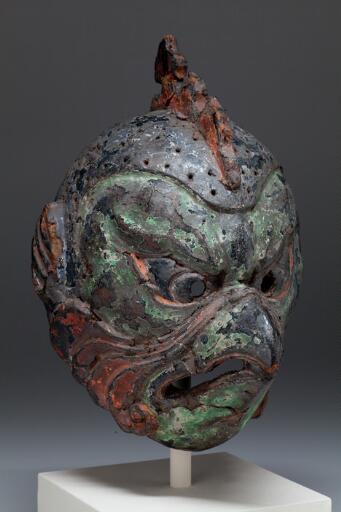
Gigaku Mask of the Karura Type, 8th century A.D.
Japanese
This very striking and expressive Japanese gigaku mask depicts Karura, one of the fourteen characters in the gigaku, a religious dance-drama that was performed for the Japanese royal court at Buddhist temple ceremonies from the 7th to the 10th century. In the performance, Karura is a mythical giant bird that protects the Buddhist faith. His features include pierced, close-set eyes, which stare down toward the tip of a prominent beak that grasps a round bead, and a cock’s comb that projects from the crown of the head. Holes covering the top of the head originally secured tufts of featherlike hair. The mask is constructed in hollow-core dry lacquer, one of the favored methods for making temple sculpture in 8th-century Japan, and bears traces of the original black lacquer coating and red, green and blue pigments.
The precise nature of gigaku (literally, “skill music”) is not clear, but it appears to have been a dramatic form of religious dance and procession performed to the accompaniment of simple musical arrangements on flute, gong, and drum. The masks were robustly expressive and basically comic in nature, as it seems the purpose of the dance-drama was to inject a note of comic relief into the solemn, time-consuming rituals of Buddhism. Gigaku was introduced into Japan from China in A.D. 612 and developed along with the spread of Buddhism in Japan.
Adult: Gigaku Mask of the Karura Type
Esta máscara japonesa gigaku, muy llamativa y expresiva, representa a Garuda, uno de los catorce personajes del gigaku, danza teatral religiosa que se interpretó ante la corte real japonesa en las ceremonias de los templos budistas desde el siglo VII al X. En esta danza, Garuda es una gigantesca ave mítica que protege la fe budista. Entre sus características se encuentran los ojos juntos y perforados, y una cresta de gallo que se proyecta desde la coronilla. Los agujeros que vemos en la parte superior de la cabeza servían originalmente para sujetar mechones de pelo que se asemejaban a las plumas. La máscara —que posee rastros del revestimiento de laca negra original, así como de pigmentos rojos, verdes y azules— ha sido fabricada con una pieza de laca seca hueca, uno de los métodos predilectos para tallar las esculturas de los templos en el Japón del siglo VIII.
Se desconoce con precisión la naturaleza del gigaku (literalmente, “música hábil”), pero parece haber sido una especie de danza-procesión de carácter teatral y religioso interpretada al son de sencillos arreglos musicales de flauta, gong y tambor. Las máscaras eran muy expresivas y de naturaleza básicamente cómica, ya que, al parecer, el objetivo de esta danza teatral era darle un toque cómico a los largos rituales solemnes del budismo. La danza gigaku llegó a Japón desde la China en el 612 d. C. y se desarrolló de la mano de la difusión del budismo en Japón.
(Hayashi Tadamasa [1853–1906], Paris and Japan);
Saburo Aoyama, Japan, 20th century;
Professor Mose Depold, Paris, to 2005;
David Newman, as agent for the seller, London;
purchased by Kimbell Art Foundation, Fort Worth, 2005.