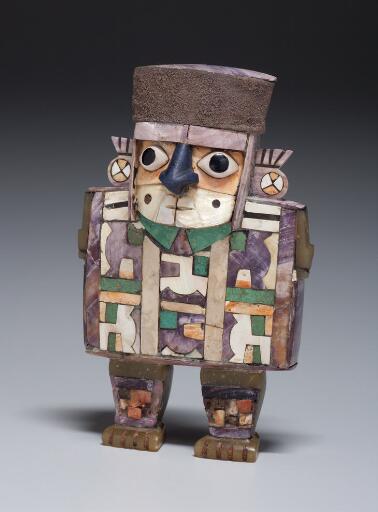
Standing Dignitary, c. A.D. 600–1000
Wari
This rare Wari freestanding figurine is composed of intricate and densely patterned inlays of mother-of-pearl, purple and orange spondylus shell, mussel shell, turquoise, pyrite, greenstone, lapis lazuli, and silver (for the headdress) on a wood matrix. The torso is cloaked in a long ceremonial tunic decorated in an interlocking tapestry weave with three rows of a simplified and abstracted zoomorphic motif, which can be read as feline (jaguar or puma) heads, or as standing llamas. The wearing of a court tapestry tunic identified one’s rank in the Wari empire, and the emphasis on the elaborateness of this costume suggests that the figure represented was a dignitary of some status. In life, tunics were worn as ceremonial garb, and in death they were placed over the wearer’s mummy bale. In shell and stone inlay, the complex textile patterns of the tunic are inevitably simplified.
The corpus of Wari inlaid material is very small. This is the only known example of a freestanding figurine entirely covered in the inlaid shell technique. The refined craftsmanship and wide range of materials used in its manufacture indicate the presence in Wari society of an elite that could afford and appreciate such a luxury item, which probably served to convey the social status of the owner. In this piece, the greenstone arms are drilled at each shoulder, possibly for suspension as a pendant.
Adult: Standing Dignitary
Children's: Standing Dignitary
Children's: Standing Dignitary, Inlay on Huari Figure
Esta excepcional figura exenta de la cultura Wari se compone de un patrón de incrustaciones complejo y denso de nácar, conchas de spondylus púrpuras y naranjas, conchas de mejillón, turquesa, pirita, piedra verde, lapislázuli y plata (en el tocado) sobre una matriz de madera. El torso se encuentra cubierto en una túnica ceremonial larga en un tejido al estilo tapiz, decorada con tres hileras de motivos zoomórficos simplificados y abstractos, que podrían leerse como cabezas de felino (jaguar o puma) o como llamas de pie. En el imperio Wari, llevar una túnica de tapiz de la corte identificaba el rango de la persona, y el énfasis que se ha puesto en la elaboración de este atuendo sugiere que la figura representaba a un dignatario de cierto estatus. En vida, las túnicas eran un atuendo ceremonial y, al morir, se colocaban sobre el fardo funerario de su propietario. Realizados en incrustaciones de conchas y piedras, los complejos patrones textiles se ven inevitablemente simplificados.
El conjunto de obras Wari con incrustaciones es muy reducido. Este es el único ejemplar conocido de una figura exenta cubierta enteramente con la técnica de incrustaciones de conchas marinas. La delicadeza con que fue ejecutada la obra y la amplia selección de materiales utilizados en su factura indican la presencia de una elite en la sociedad Wari que podía pagar y apreciar semejante artículo de lujo, que probablemente sirviera para plasmar el estatus social de su propietario. En esta pieza, los brazos de piedra verde están perforados en los hombros, posiblemente para utilizar la figurilla como colgante.
(André Emmerich) and Alan Lapiner, by 1970;
purchased by Alice M. Kaplan, 1970–1999;
(sale, Sotheby's, New York, 2 June 1999, no. 17);
purchased by Private Collection, United States, 1999–2002;
purchased through (Sotheby’s, New York) by Kimbell Art Foundation, Fort Worth, 2002.