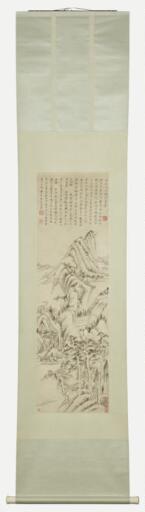
Steep Mountains and Silent Waters, 1632
Dong Qichang, Chinese
Dong Qichang, one of the most celebrated figures in the history of Chinese art, is equally renowned for his painting, calligraphy, and theoretical writings on painting. In his own work, Dong was an innovative artist who used the elements of traditional landscape painting––line, contour, shading, and spatial relationships—as an abstract, formal vocabulary with which to create a variety of new modes of landscape. In this way Dong single-handedly infused new life into Chinese painting at a time when the Ming dynasty (1368–1644) schools were in decline.
This scroll is Dong’s last dated work, painted when he was seventy-eight years old. The painting’s composition, as well as its idiosyncratic stylistic features, are characteristic of Dong’s mature, highly intellectual style, notably the sharp precipices, bare angular patches, and unexpected spatial juxtapositions of the dry mountain peaks. The form of the mountain that winds vertically up the center of the painting, and the long thin strokes used to define its surface, are recurrent elements in his landscapes. The treatment of certain motifs—the trees, the house, and foreground rocks—is more brittle and drier than in earlier paintings and may be regarded as evidence of Dong’s advanced age.
Dong Qichang, uno de los personajes más famosos de la historia del arte chino, es reconocido de igual modo por su pintura, su caligrafía y sus escritos teóricos sobre la pintura. En su propia obra, Dong fue un artista innovador que aplicó los elementos de la pintura de paisajes tradicional —líneas, contornos, sombreado y relaciones espaciales— como un vocabulario formal abstracto con el que crear una variedad de nuevos modos de paisaje. De esta manera, Dong por sí solo infundió nueva vida a la pintura china en una época en la que las escuelas de la dinastía Ming (1368–1644) se encontraban en franca decadencia.
Este rollo, que Dong pintó a sus setenta y siete años, es su última obra datada. La composición de la obra, así como sus marcas de estilo idiosincráticas —en particular los abruptos precipicios, las zonas angulares vacías y las inesperadas yuxtaposiciones espaciales de las cimas secas de las montañas—, son características del estilo maduro y altamente intelectual de Dong. La forma de la montaña, que gira verticalmente en el centro de la pintura, así como las delgadas pinceladas alargadas utilizadas para definir su superficie, son elementos recurrentes en sus paisajes. El tratamiento de ciertos motivos —los árboles, la casa y las rocas en primer plano— tiene un aspecto más quebradizo y seco que en obras anteriores y podría entenderse como prueba de la provecta edad del artista.
He Xianggang (Ho Hsiang-kang), Guangdong;
Weng Songnian (Weng Sung-nien, 1647-1728);
Pan Zhengwei (P’an Cheng-wei, 1791-1850);
Gu Wenbin (Ku Wen-pin, 1811-1888);
Ho Kwan-wu, Hong Kong (d. about 1974);
Zhou Huaimin (Chou Huai-min);
Zhang Daqian (Chang Ta-chien, 1899-1983);
Etablissement des Beaux-Arts du Monde, Vaduz, Liechtenstein, since 1979;
(N. V. Hammer, Inc., New York) as agent for the Etablissement des Beaux-Arts du Monde, Vaduz, Liechtenstein;
purchased by Kimbell Art Foundation, Fort Worth, 1980.