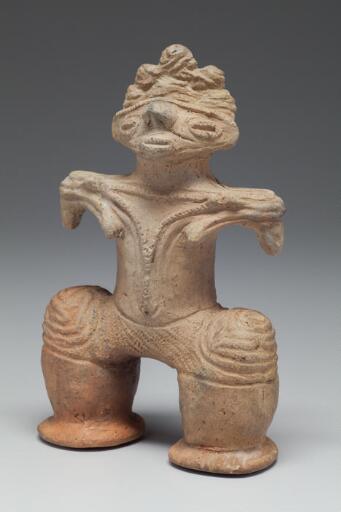
Female Figurine, c. 1000–200 B.C.
Japanese
Jomon clay figurines, called dogu (earthen idols), began to appear around 1500 B.C. Representing humans, usually female, and animals, they have in common with the pottery vessels the characteristic cord-marked decoration on their bodies and faces, and may have been used as protective charms or fertility symbols. Most were found deposited in pit dwellings, burial sites, or ritual shrines. The figurines exhibit a variety of abstract, humanoid shapes that are highly imaginative. This figurine has a hollow, thin-walled body supported by short tubular legs and wide hips. The areas of smooth clay and contrasting bands of incised and cord- marked patterns on the face, hips, and chest, as well as the “goggle-eyes,” are identifying features of the so-called Kamegaoka type of dogu figurine.
Las figurillas Jomon de arcilla, llamadas dogu (ídolos de barro), comenzaron a aparecer alrededor de 1500 a.C. Representan tanto a humanos, por lo general mujeres, como animales. Tienen en común con las vasijas de cerámica la decoración típica de marcas hechas con cuerda en el cuerpo y en el rostro, y es posible que hayan sido utilizadas como amuletos protectores o como símbolos de fertilidad. La mayoría fueron halladas en viviendas subterráneas, en tumbas, y en altares para rituales. Las figurillas exhiben una variedad de formas abstractas y humanoides sumamente imaginativas. Esta figurilla tiene un cuerpo hueco de paredes delgadas que se apoya en unas piernas cortas tubulares y caderas anchas. Las partes lisas de la arcilla que contrastan con las incisiones y marcas hechas con cuerda en el diseño del rostro, caderas, y pecho; así como los ojos anchos y saltones, son atributos identificadores de las figurillas dogu, llamadas Kamegaoka.
Okura Collection, Tokyo;
(Kochukyo Co., Ltd., Tokyo);
(N. V. Hammer, Inc., New York);
purchased by Kimbell Art Foundation, Fort Worth, 1971.