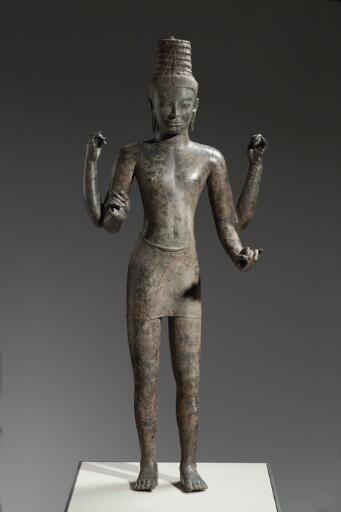
The Bodhisattva Maitreya, late 8th century A.D.
Thai (pre-Khmer)
The earliest surviving Buddhist images in Southeast Asia, dating from the fourth and fifth centuries A.D., were the bronzes brought from India and Sri Lanka by merchants and monks. The first locally made images date to the sixth century and demonstrate that regional styles were already developing. One of these regional styles is represented by a group of bronzes unearthed in 1964 in the base of an abandoned temple in the village of Prakhon Chai, in northeast Thailand.
This graceful sculpture is one of the largest and most beautiful of the hoard. The four-armed bodhisattva—one of the divine beings who put off their own final nirvana to assist mankind—can be identified as a Maitreya, the bodhisattva of the future, on the basis of the small stupa (a venerated Buddhist structure) located at the base of his coiffure. The four arms indicate his divinity and represent a multiplicity of powers. Very different from the typical Indian bodhisattva images, which are dressed in skirts, flowing scarves, and abundant jewelry, this figure has a slender, bare body, clothed only in a short garment covering the loins, in a manner more characteristic of Cambodian art. The scanty clothing, lack of jewelry, and unkempt hair indicate that this sculpture represents a bodhisattva-ascetic, one who practices austerities in order to attain spiritual enlightenment.
Las imágenes budistas más antiguas que se conocen en el sudeste de Asia, que datan de los siglos IV y V d.C., son los bronces llevados allí desde la India y Sri Lanka por mercaderes y monjes. Las primeras imágenes esculpidas localmente datan del siglo VI y demuestran que los estilos regionales todavía se encontraban en desarrollo. Uno de estos estilos regionales se encuentra representado por un grupo de bronces descubiertos en 1964 en la base de un templo abandonado en el pueblo de Prakhon Chai, al noreste de Tailandia.
Esta elegante escultura es una de las más grandes y bellas de aquel tesoro. El bodhisattva de cuatro brazos —uno de los seres divinos que postergan su propio nirvana para ayudar a la humanidad— puede identificarse como Maitreya, el bodhisattva del futuro, sobre la base de la pequeña estupa (estructura budista venerada) que vemos en la base de su peinado. Los cuatro brazos señalan su divinidad y representan una multiplicidad de poderes. Esta figura, muy diferente a las imágenes de bodhisattvas típicas de la India —que llevan faldas, fluidos pañuelos y abundante joyería— presenta un cuerpo delgado y desnudo, cubierto únicamente por un corto atuendo que cubre sus entrañas, siguiendo un estilo más característico del arte de Camboya. Las escasas vestiduras, la ausencia de joyería y el cabello despeinado indican que esta escultura representa a un bodhisattva ascético, que practica la austeridad para alcanzar la iluminación espiritual.
(Ellsworth & Goldie, Ltd., New York);
purchased by Kimbell Art Foundation, Fort Worth, 1965.