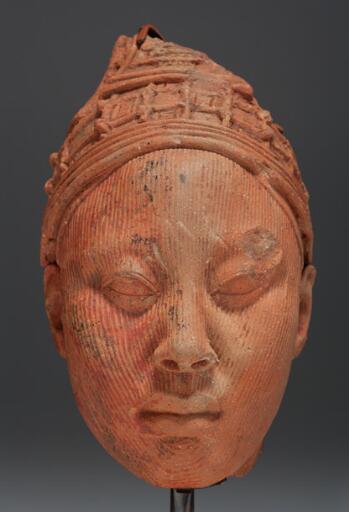
Head, possibly a King, 12th–14th century
Ife
The art of Ife, which flourished from the twelfth to the fifteenth century in southwestern Nigeria, in the area occupied by the Yoruba people, is unique in Africa in representing human beings with extraordinary naturalism. The subject matter of most Ife art is centered around royal figures and their attendants, reflecting the political structure of a city-state ruled over by a divine king, the Oni of Ife. Sculpted heads were buried in the ground at the foot of giant trees and resurrected when they were used ritually as offerings or sacrifices, sometimes on an annual basis. Ife bronzes and terra-cottas have been recovered from groves containing sacred shrines, from crossroads, and from older sections of the Ife palace compound.
The physiognomy of this head has been modeled with extraordinary subtlety, and the striations, which may represent scarification patterns, are incised with great delicacy. The square crown, formed of four rectangular aprons overlying a conical form and embellished with a network of intersecting beads, is unparalleled in any other known examples of Ife art. Like the vast majority of Ife heads in terra-cotta, the Kimbell example seems to have been broken from a full-length figure. The serene and dignified countenance, as well as the elaborate crown, suggests that this head represents an Ife king (Oni).
Adult: Head, Possibly a King
El arte de Ife —que floreció en una zona ocupada por el pueblo yoruba, en el sudoeste de Nigeria, entre los siglos XII y XV— es único en África por su extraordinario naturalismo a la hora de representar seres humanos. La temática predominante en el arte de Ife gira en torno a las figuras reales y sus asistentes: sus obras reflejan la estructura política de una ciudad-estado gobernada por un rey divino: el Oni de Ife. Las cabezas esculpidas se enterraban en el suelo, a los pies de árboles gigantes, y resucitaban cuando se las utilizaba como ofrendas o sacrificios rituales, que a veces se realizan anualmente. Se recuperaron bronces y terracotas de Ife en arboledas que contienen santuarios sagrados, en encrucijadas y en las sectores más antiguas del recinto palaciego de Ife.
La fisonomía de esta cabeza se modeló con una magnífica sutileza, y los surcos de la estriación —que puede representar patrones de escarificación— están labrados con gran delicadeza. La corona cuadrada, compuesta por cuatro telas rectangulares que recubren una forma cónica y están ornamentadas con una red de cuentas entrecruzadas, es de una calidad sin precedentes con respecto a otras piezas conocidas del arte de Ife. Tal como sucede con la gran mayoría de las cabezas de Ife hechas en terracota, esta pieza del Kimbell parece haber formado parte de una figura de cuerpo entero. La serenidad y dignidad del semblante, junto con la elaborada corona, indicarían que esta cabeza representa a un rey de Ife (Oni).
Private collection, Switzerland;
purchased by (L & R Entwistle & Co., Ltd., New York and London);
purchased by Kimbell Art Foundation, Fort Worth, 1994.